Come see the latest Astronomy books—and talk to the editors that published them. This is your chance—if you’re attending 247th Meeting of the American Astronomical Society—to talk one-on-one with Springer Nature editors, to look through and buy new and essential books, and more.
When you visit the Springer Nature booth 611, you can talk to some of the most experienced editors working in scholarly publishing. These experts can answer any questions you might have and can explain the ins and outs of today’s publishing landscape, including open access (OA), what’s involved in writing and publishing a book, and more.
And you can see the full range of Astronomy publications at Springer here. On these pages, you’ll find more detailed information about the books, journals, and services you’ll see highlighted especially for 247th Meeting of the American Astronomical Society.
Springer Nature’s leading imprints


Cosmic Events: The Three Comets of 1618
This book offers a comprehensive study of the comets of 1618, a year that marked a turning point in European history with the onset of the Thirty Years’ War. Contributions by eleven scholars reveal how the Great Comet and its predecessors shaped science, politics, and culture across Europe, Spain, India, and China. Topics include poetry in England and the Netherlands, an unpublished German manuscript, and the comet’s impact on belief and worldview. A must-read for historians, astronomers, and curious minds.
Find out more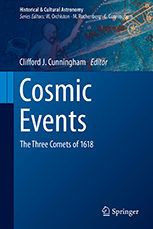
An objective and well-argued perspective on the topic of future Mars missions
In an era of public Mars fascination, the book Mars and the Earthlings by Verseux et al. offers an objective presentation of the challenges of crewed Mars missions and discusses scenarios of Mars settlements under scientific, technical, social, economic , ethical and political aspects. With the aim to make the reader comprehend what is plausible and what is at stake, the book tries to clarify misconceptions and half-truths spreading rapidly in the public.
Visit the book webpage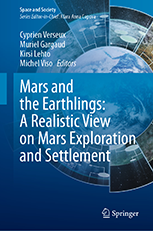
Book Publishing Essentials: Free mini-course
What do you need to know to successfully navigate the book publishing process? In this free mini-course, you’ll receive everything you need to know, directly to your inbox.
Sign up now
Get answers from expert editors—here’s who you will meet at our booth
You’re attending 247th Meeting of the American Astronomical Society because you have results to share. But what’s the best way to reach the widest appropriate audience? The Springer Nature editor who is here can help answer that question. You can take the opportunity to meet with Dr. Avachat. If you haven’t written a book before, she can give you a quick introduction to the process. And if you have, she can show you how publishing a book with Springer would be different from other publishers. She can also help answer any questions you might have about Springer journals.

Dr. Sayali Avachat
Editor, Books
Astronomy
Springer Nature, New York, US
Publishing with Springer Nature
Every kind of article or book you might write can find its home here, including in fully OA books and journals. So you can see for yourself, Dr. Avachat has hand-chosen examples that demonstrate the quality, breadth, and depth of what we publish; and also how your research might find its place here. If you already have a book idea in mind, you can discuss it directly with an experienced Publishing Editor. Find out what makes publishing your book with Springer Nature different.
The books and journals below illustrate the scope and quality of the research published here.
Books
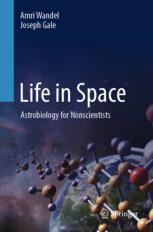
A. Wandel, J. Gale
Life in Space
Astrobiology for Nonscientists
- A concise primer on the field of astrobiology
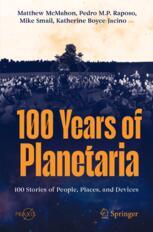
M. McMahon, P. M. P. Raposo, M. Smail, K. Boyce-Jacino
100 Years of Planetaria
100 Stories of People, Places, and Devices
- Presents a highly-readable and widely illustrated history of planetaria
Pierre Léna, Serge Koutchmy
Eclipsed Suns, the Solar Corona and Exoplanets
From Concorde 001 to Telescopes in Space
- Tells the unique story of observing a total solar eclipse for no less than 74 consecutive minutes aboard Concorde 001
L. Vacca
Life Beyond Earth
The Fermi Paradox -- Or Why We Are Still Waiting to Meet Aliens
- Provides a compact and accessible treatment of life beyond Earth and why we have yet to encounter it

A.E.L. Davis, J. V. Field, T. J. Mahoney
Reading the Mind of God
Johannes Kepler and the Reform of Astronomy
- A comprehensive collection of in-depth essays on a major figure in the history of science
W. D. Cummings, L. J. Lanzerotti
Scientific Debates in Space Science
Discoveries in the Early Space Era
- Winner of the 2024 IAA Basic Science Book Award
J. E. Beckman
Galaxies in an Accelerating Universe
- Reveals to the reader the beauty of galactic and extragalactic astronomy
Journals
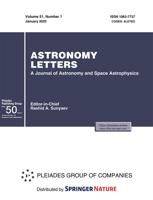
Astronomy Letters
EiC Rashid A. Sunyaev
A Journal of Astronomy and Space Astrophysics
- Publishes original research results in all branches of modern astronomy and astrophysics
- Topics include high energy astrophysics; cosmology; space astronomy; theoretical astrophysics; radioastronomy; extra-galactic astronomy and more
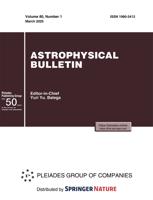
Astrophysical Bulletin
EiC Yuri Yu Balega
- Presents original and review papers in various fields of modern astrophysics
- Coverage includes problems of astrophysical observations of stars and galaxies, cosmology, astrophysical instrumentation
- Also publishes scientific reviews, chronicles, and proceedings of international conferences
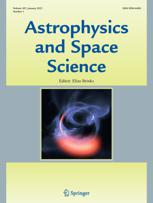
Astrophysics and Space Science
EiC Elias Brinks
An International Journal of Astronomy, Astrophysics and Space Science
- Astrophysics and Space Science publishes the yearly Astronomy Prize Awardees Collection series
- The journal welcomes data-driven publications such as descriptions of astronomical catalogs, software including simulations, and observational surveys
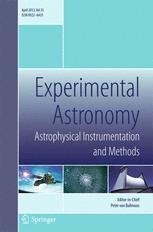
Experimental Astronomy
EiC Peter von Ballmoos
Astrophysical Instrumentation and Methods
- Reports on astrophysical instrumentation and methods encompassing all astrophysical messengers
- Publishes full-length articles, research letters and reviews on detection techniques, instruments, and data analysis and image processing techniques
General Relativity and Gravitation
EiC Eric Poisson, Mairi Sakellariadou
- Founded in 1970, it was the first journal dedicated to the classical theory of general relativity
- Publishes in both subscription and open-access model
Microgravity Science and Technology
EiC Valentina Shevtsova
An International Journal for Microgravity and Space Exploration Related Research
- Publishes papers on studies performed on platforms providing real and simulated microgravity conditions
- Welcomes research on instrumentation as well as theoretical gravity-related considerations
Solar Physics
EiC Inigo Arregui, Cristina H. Mandrini, Lidia Driel-Gesztelyi, Marco Velli
A Journal for Solar and Solar-Stellar Research and the Study of Solar-Terrestrial Physics
- Reports on all aspects of solar physics, from the Sun's internal structure and evolution to the outer corona and solar wind in interplanetary space
- Also publishes relevant papers on stellar research and solar-terrestrial physics
Space Science Reviews
EiC Olivier Witasse
- Established in 1962 with an emphasis on scientific results and instruments of space science
- Covers astrophysics, physics of planetary systems, solar physics, and physics of magnetospheres and interplanetary matter
Open access
Serving the global research community with openness, rigor, quality, and transparency
Open access (OA) refers to the free, immediate, online availability of research outputs such as journal articles or books, combined with the rights to use these outputs fully in the digital environment. Publishing OA expands the reach of your research, fostering greater impact, visibility and usage of your work. Studies indicate that gold OA articles achieve significantly more downloads, citations, and Altmetric attention than non-OA articles.
You may be able to publish OA, with your fees covered, through one of Springer Nature’s many OA agreements. Alternatively, you can use our free OA funding and support service to find and apply for funding to cover your article processing charges (APCs) and/or book processing charges (BPCs).
Ultimately, serving the research community means research that’s open to all. And the only way to achieve full, immediate, and sustainable OA is by prioritising gold OA.
Below you’ll find a selection of OA journals and books that our editors have chosen as of particular interest for 247th Meeting of the American Astronomical Society.
Journals
 Open Access
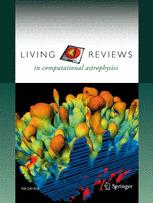
Living Reviews in Computational Astrophysics
EiC Ewald Müller
- Publishing reviews of research in all areas of computational astrophysics
- Maintaining a suite of high-quality reviews, which are kept up-to-date by the authors
- Founded by the Max Planck Institute for Astrophysics
 Open Access
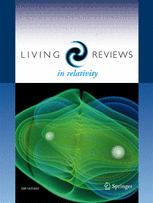
Living Reviews in Relativity
EiC Piotr T. Chrusciel
- Publishing critical reviews of research in all areas of relativity
- Maintaining a suite of high-quality reviews, which are kept up-to-date by the authors
- Founded by the Max Planck Institute for Gravitational Physics (Albert Einstein Institute)
 Open Access
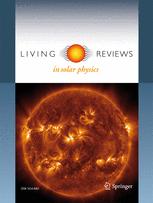
Living Reviews in Solar Physics
EiC S.K. Solanki
- Publishing reviews of research in all areas of solar and heliospheric physics
- Maintaining a suite of high-quality reviews, which are kept up-to-date by the authors
- Founded by the Max Planck Institute for Solar System Research (MPS)
Books
 Open Access
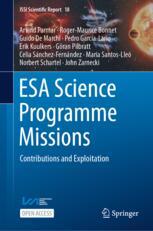
A. Parmar, R. Bonnet, G. De Marchi
ESA Science Programme Missions
Contributions and Exploitation
- The first systematic study of the publications from the ESA Science Programme's missions
 Open Access
R. T. Schilizzi, R. D. Ekers, P. E. Dewdney, P. Crosby
The Square Kilometre Array
A Science Mega-Project in the Making, 1990-2012
- Describes the first two decades of development of an unusual mega-(science) project